Wednesday, April 5, 2023

Race Report: Georgia Death Race 2023

It's been a while since my last race report.  Lots has happened.  Fitness lost, fitness gained.  Injuries.  Work/life stress.  Global pandemics.  The usual...

Long story short, I regained all the weight I lost in 2020, and then dropped it all again last year (and into this year).  Going into GDR '23, I was probably close to my all-time best fitness as well as my lowest weight since high school.  Countless hours spent on the stair machine had given me super-strong quads ready to tackle the Georgia mountains.  I did a lot of running on a recent trip to Mexico, which gave me confidence to cruise for 10-20 miles in the heat.  I felt ready.  The only "wild cards" (I thought) were whether my left knee and right Achilles could take the strain of the "74-ish" miles that make up the GDR course.

I drove down the day before the race with my crew (Jill and Liz).  We arrived at Amicalola Falls just in time for packet pickup and the pre-race briefing.  There weren't any real surprises there, since the race directors were pretty good about making information available in the weeks leading up to the race.  One welcome change for this year's event was that trekking poles would be allowed, but only after reaching the first aid station.  Having done the race a couple times before, I fully supported not having them at the start -- it would be a total clusterf#ck having 300+ people with poles scrambling up the narrow single-track trail that comprises the first huge climb.

Anyway, after the briefing, we grabbed dinner, went back to the room, organized stuff for the morning, and tried to get some sleep.  The race starts at 5am and is a point-to-point race.  Amicalola Falls is the *finish*, so there are shuttles to take the runners to the start in the morning.  The shuttles leave at 2:45am, which means I had to wake up around 1:30am to have enough time to get ready and get down to where the shuttles would be.  Nothing like starting a 20-25hr race on 3.5 hours of sleep!

Morning came quickly.  I got ready, and got on the 3rd of 4 school busses that were the shuttles.  Not a comfortable ride by any means, but it was getting us where we needed to go - until it wasn't.  Yep - our bus broke down about 10 miles from the start line.  Fortunately, the bus behind us also stopped.  Eventually, we determined there was enough room to cram everyone on the 4th bus for the remainder of the trip.  We got there about 4:30am - just enough time to use the bathroom and eat some more of my junk food breakfast:  Pop Tarts, Swiss Rolls, Hostess Apple Pies, 5-Hour Energy -- truly a breakfast of champions.

About 5 minutes before the start, the skies opened up and it started *pouring* rain.  This was expected, but still not welcome.  At least it was around 60 degrees, so we didn't have to worry about hypothermia or anything.  Most everyone seemed appropriately dressed for the weather.

Finally - the race starts! In prior years, the course started almost immediately on the single-track hiking trail.  This year, we had about 2 miles of (downhill) road before hitting the trail.  This made for a very fast start (my first mile was a little over 8 minutes) and allowed the field to spread out a bit before getting bottlenecked on the single track.

We charged up the climb to Coosa Bald.  My heart rate was a little higher than I wanted (150-155 bpm) but I felt okay.  I ended up disabling the "high heart rate" alert on my watch, since it uses battery every time it goes off by lighting up the backlight, vibrating, and beeping.  I was pretty sure it would last anyway, but didn't want to take the chance of it dying before the end.  My plan was to re-enable the alert later once things settled down.

The rain made for a little slippage as we climbed, but it wasn't too bad.  The problem was the descents - the first of which was down into the first aid station:  White Oak.  At this point, there were probably 40ish people in front of me and the trail was already trashed.  You could see where people were sliding all over the place and it made the descent very challenging.  Downhill technical running is where I usually make up time, and now that was taken away.  Fortunately, my fitness gains translated into faster ascents, so it kinda canceled out.  Still, it made me very wary of my knees, ankles, and Achilles.  One misstep could put me out of the race.

We half-ran, half slid into White Oak around 1:51 from the start.  Based on my previous times at GDR, I had guessed it would take around 2:15.  So I'm already 24 minutes ahead of where I thought I would be.  I also had allowed for a 5-minute stop to grab food and water.  I still had plenty of water & gatorade to get me to the next aid station, so I slowed down enough to grab a banana, and kept going.  Let's call it a 30-second stop, though it was probably less than that.  So, leaving White Oak I was around 28 minutes ahead of schedule.

The course between AS1 and AS2 (Mulky Gap) was tough, but only because of the rain.  The trail was a complete mess.  This was more of a mud run than an ultramarathon.  Fortunately, I could use the one trekking pole I carried from the start now.  This allowed me a little more traction on the climbs, and a little more stability on the descents.  Why one pole instead of two?  Well, I found that when I use trekking poles, I tend to not eat and drink as often - which is critical in an ultramarathon.  So I thought using one pole would give me most of the benefit, but still leave a hand free for eating and drinking.  Seemed like a good compromise, and I think it worked well.

It wasn't long into this section that I slipped and twisted my knee.  The left one, of course.  The problematic one.  The one I was worried wouldn't make it to the end.  "Great", I thought.  This is what takes me out.  It isn't fair.  I popped some pain meds and hoped I would be able to work through it.

Not long after that, I slipped again and fell on my right side, catching myself on my right forearm.  My right shoulder instantly hurt.  Things are not looking good now.  Still, I went on.  The pack has spread out a bit and I'm not feeling as claustrophobic as I was going into the first aid station.  Still, there are runners within sight ahead and behind me at this point.  

I get to Mulky Gap around 3:21.  I had predicted 3:35, with another 5 minute stop.  I quickly refilled water, grabbed some bacon and quesadillas, and was moving again at 3:24.  A quick, 3-minute stop.  Very nice.  So I'm still 16 minutes ahead of schedule.

Having efficient aid station stops was a point of emphasis for this year.  I burned a lot of time at aid stations in my previous 2 appearances.  In 2021, that lost time caused me to miss the final cutoff (at Nimblewell) and DNF.  I figured I could cut an hour off my 2018 finishing time just by making my aid station stops shorter.

By this point, the rain had stopped and the trail was in slightly better condition.  You still had to be careful, but it was much more runnable.  I made good time getting to the third aid station (Skeenah Gap) which was the first place I would see my crew.  As I got closer to Skeenah, I realized I was way ahead of schedule.  Would I arrive before they got there?  It wouldn't be a disaster if I did, but it would be nice to drop some of my cold/rainy-weather clothes and swap them for lighter/cooler stuff as the temperature was starting to rise.
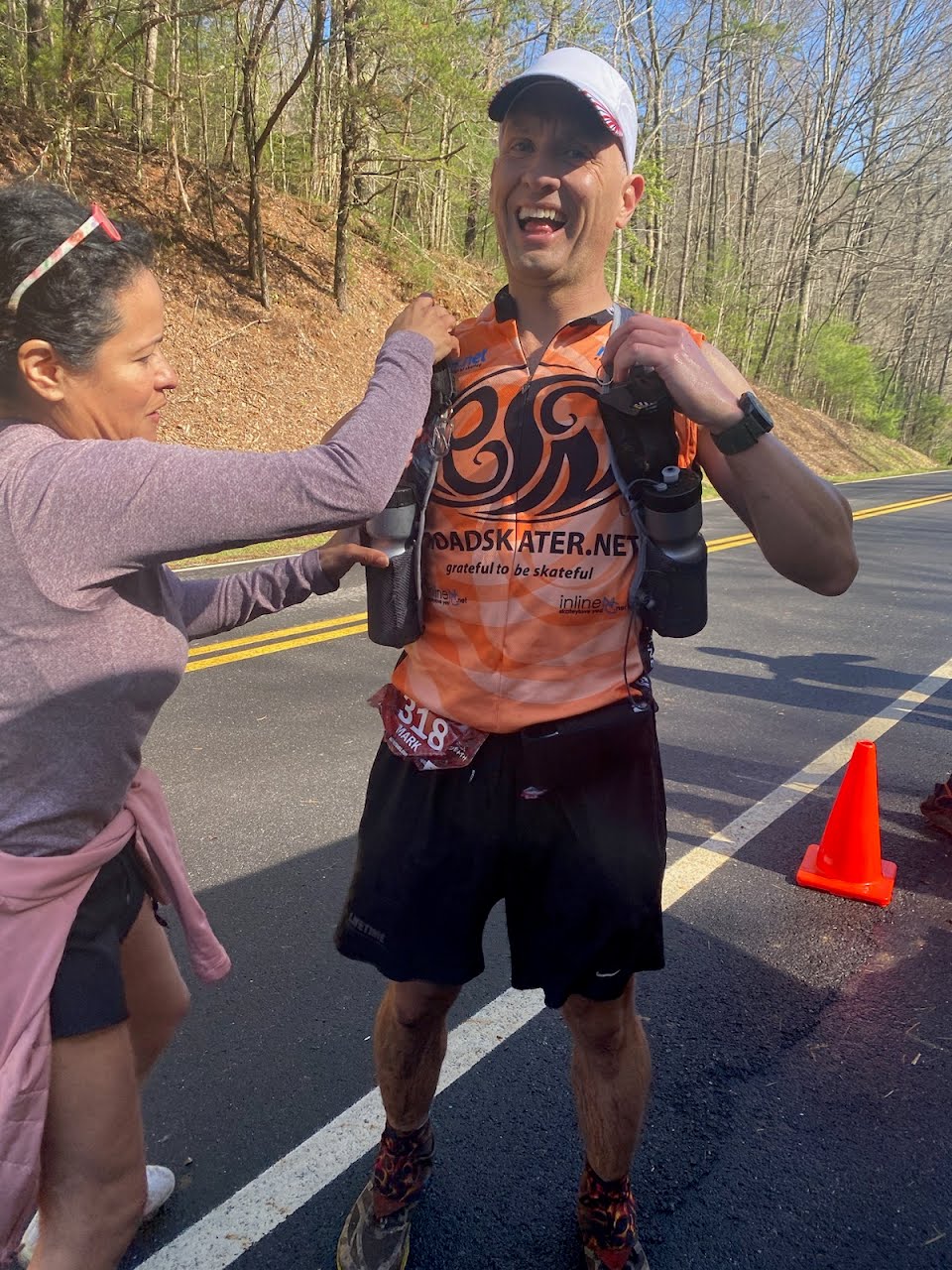
I got to Skeenah Gap (20.3 miles) around 5:28.  I had predicted 5:55.  I look around, and there is no sign of Jill or Liz.  So I start refilling my hydration pack and bottles, and grab some food.  As I'm getting ready to leave, I see Liz coming down the hill with the wagon, followed by Jill.  I get Liz's attention and start taking off my rain jacket, short-sleeved shirt, and long-sleeved shirt that I started the race with.  I get a dry sleeveless jersey from Liz, as well as a dry running hat.  I also grabbed a bluetooth earbud so I could get some tunes going.  Liz swapped-out my hydration bladder and bottles.  Even with the slight delay, the stop was only 10 minutes - which is what I had planned for the crew-accessible aid stations.  So I'm still 27 minutes ahead of schedule when I leave, and 87 minutes ahead of the cutoff.

Going into Skeenah, there is a mile+ out-and-back that is mostly downhill.  So, leaving Skeenah, you have to climb that to get back to the "main" part of the course.  After that, there is a little more climbing, then it's mostly downhill into AS4 - Point Bravo.  I don't recall much from this section, other than I was still feeling good.  My knee was holding up okay.  My shoulder wasn't really bothering me.  I was still eating and drinking well.  I felt strong on the uphills and the trail had dried enough that the downhills were safely runnable.  I made good time and got there around 7:08, grabbed a fistful of bacon and a couple quesadillas, and kept going.  When Liz swapped my bladder & bottles, I had about twice as much fluids as I needed - so I had plenty to get me to the next aid station already.  I spent maybe 1 minute at Point Bravo.  Leaving at 7:09, I was 46 minutes ahead of schedule and almost 2 hours (1:54) ahead of the cutoff.

Getting to AS5 (Sapling Gap - 30.9 miles), there is an initial climb, followed by a lot of runnable trail.  You get to cross the very scenic "Swinging Bridge". Then it's just over a mile to the aid station.  Sapling Gap is another crew-accessible aid station, and I was expecting to see Jill and Liz there.  And they were.  By now, the temperature was getting quite warm, so we moved a chair into the shade and got to work.  My shoes and socks were still soaked from the rain and mud, so we changed those out.  I changed shirts again.  We soaked my hat in cold water.  I chugged an ice-cold Miller Lite.  I don't recall what food they had at the aid station, but I don't recall taking anything with me.  I'm pretty sure I just stuck with my sugary snacks.  I arrived around 8:28 and left around 8:55.  So a bit of a longer stop here, but changing the shoes was definitely a good move and I had plenty of buffer.  I was still 35 minutes ahead of schedule, and 1:55 ahead of the cutoff.

So...  now I'm nine hours into this thing.  Still feeling okay.  Obviously "feeling" the effort.  But I'm starting to think about my potential finishing time.  After all, the hardest climbs on the course were behind me.  There was an outside chance I could finish around (or under) 20 hours!!  That would be insane, considering my 2018 finish was around 22 1/2 hours.  Even more insane considering the conditions at the start of the race!

I cruised to AS6 - Long Creek.  36.8 miles.  Halfway done.  Arrived 10:44.  Left 10:46.  Don't remember much about that section.  Looking at the elevation profile, there was a little climbing at the start, then some rolling hills.  Very runnable.  I'm now 46 minutes ahead of schedule, and 2:06 ahead of the cutoff.  The next time I see my crew is AS8, so I have one more aid station (Winding Stair) before then.

Long Creek to Winding Stair starts off very runnable and ends with a climb to the aid station.  Nothing crazy, but you feel it after 40+ miles.  It was in this section that things started to go awry...

About 30 minutes after Long Creek, my stomach started feeling a little "off".  A little strange, but it has happened before.  It's never been a hindrance in a race.  Over the next 10-15 minutes, though, I felt more and more nauseated.  Then, around 11.5 hours into the race - I found myself bent over at the side of the road, heaving.  Two minutes later, I felt better and was back moving again.  30 minutes later - I was dry heaving.  And again, 15 minutes after that.

I texted my crew and let them know the situation, and that I was planning on sitting down for a bit at AS7 to try to settle my stomach.  I got into Winding Stair at 12:25.  At this point, I was still 35 minutes ahead of schedule and 2:20 ahead of the cutoff.  I sat down, got some ginger ale, and asked for a plain tortilla to nibble on.  My stomach is definitely not happy, but things are staying down - for now.  Still, I'm not making much progress on the tortilla.  Precious minutes go by.  At 13:13 (nice omen there), I decide that sitting isn't doing much good, so I may as well start walking at least.  Now, I'm 8 minutes behind schedule but still 1:32 ahead of the cutoff.

I ate a bunch of Tums, and that seemed to help for a little bit.  I may have even run a couple miles.  But, about an hour later, I was retching on the side of the road again.  The section from Winding Stair to Jake Bull (AS8) should be the fastest and easiest on the whole course, and I'm walking it - with periodic pauses to vomit.  All that buffer I had built up is slipping away.  Dreams of a PR are gone.  Now, even
finishing the race is a gigantic question mark.
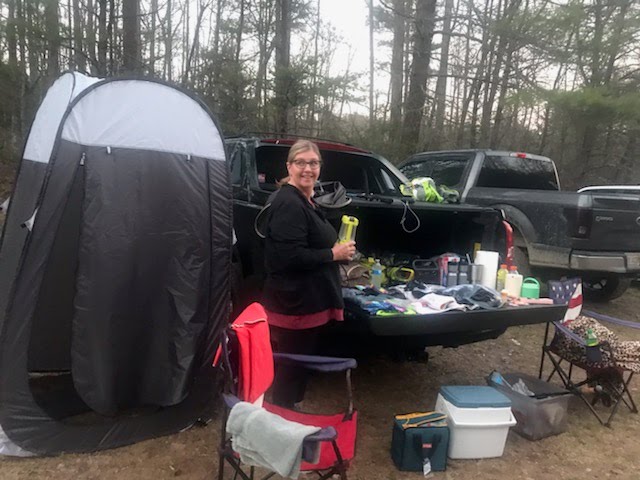
I threw-up and/or dry-heaved 6 times between Winding Stair and Jake Bull.  (That's 9 total so far, for those keeping count.)  I should have made it to the aid station long before sunset, but I end up getting out my headlamp for the last mile or two.  At 15:35 (8:35pm) I finally see my crew.  I'm now 55 minutes behind schedule as I enter the aid station.

I immediately sat down.  My crew was prepared with tummy-friendly food, but I couldn't eat much of it.  I shivered under a blanket.  I eventually changed into some dry clothes - and warmer clothes for the night section of the course (including my new running kilt).  As I had been approaching the aid station, I had made peace with the likely DNF that would occur.  I honestly wasn't sure if I had enough time to make the cutoff for the final aid station (Nimblewell) or the overall 25-hour cutoff for the race.  I probably didn't have enough buffer to just walk it in.  Even if I did, I was losing about 2 minutes every time I had to stop to vomit.

My crew encouraged me to get up and get going.  "There's still time.  Don't quit."  For me, I'm wondering if it's even physically possible to complete the course if I'm not able to hold down any food or liquids.  Almost an hour goes by.  It's now or never.  If I don't get moving, there definitely won't be enough time.  So, I decide to give one more push.  I grabbed a banana just in case I might be able to eat it, and left the aid station at 16:37.  Forget about being on schedule now.  It's all about cutoffs, and I left 23 minutes ahead of the Jake Bull cutoff.  (Remember the good times when I was 2 hours ahead of the cutoffs?)  I had to reach Nimblewell, and leave, before 21:00 on the race clock (2am).

I was walking, but walking "with purpose".  There is a short-ish trail section after Jake Bull before you exit out onto a road and start a 7-mile climb up the the aid station.  The course is slightly different than when I did it in 2018 and 2021. The previous course was maybe half road, then half trail.  Now, it's all road.  And it goes *forever*.  A constant 9-10% grade.  Unrelenting.  And it's dark.  And you're sleep deprived.  I actually nodded-off several times while hiking up that road.  I had picked up my second trekking pole at Jake Bull, so I never fell.  But the siren call of sleep was strong.  All I wanted was to go to sleep.  The side of the road would be fine.  I didn't need a bed, or anything.  Just to lay down and close my eyes.

But I didn't.  At least, not except for the "micro sleeps" that happened during the death march up the mountain.  You hear stories of runners "hallucinating" during ultramarathons.  I wouldn't say that I hallucinated, but my brain was definitely misinterpreting what it saw.  At no point did I actually think I was seeing things that weren't there.  But there were several times where, out of the corner of my eye, it looked like there was someone there hiking beside me.

The road went up and up and up.  I kept waiting for the turn onto the "trail section".  At that point, I thought they had only moved the aid station - not that they had changed the course.  Once in a while, I would question if I was still on the course.  But I had preloaded the course on my watch, and it would alert me if I were off-course.  So I kept trudging along and would eventually see a course marking a few minutes later.  Maybe 2/3 into the climb, the "sweepers" caught up to me.  That meant I was the last runner.  No other runners behind me.  My tired brain had thought I had more time to reach the aid station than I really had.  But even once I figured out my miscalculation, I figured I would just barely make it in time.  The sweepers kept me company until we came across another runner, sitting down on the side of the road.  (He looked fine, and in good spirits.  Just obviously had decided he had had enough.)  So I continued on to Nimblewell, leaving the runner and two sweepers behind.  Along that long climb, I had to stop **13** times to vomit or dry-heave.  Each stop took 1-2 minutes.  Still, I kept going.

I made the final turn toward the aid station and saw a car coming my way.  I recognized the driver as the race director.  He slowed down, leaned his head out of the window, and said "If you want to continue, you better start jogging!  The aid station is just up ahead."  I looked at my watch and saw I had 5 or 6 minutes before the cutoff.  Unless I had misjudged the location of the aid station, I should be able to walk it in.  Still, I didn't want to miss the cutoff by minutes (or seconds), being that close.  So, I started jogging.

I got to Nimblewell 2 minutes before the cutoff.

Nimblewell was probably my shortest stop of the day.  I stopped long enough to tell the aid station volunteers I was moving on, and that I didn't need anything.  I had barely drank any of the water I took from Jake Bull, so there was plenty to get me to the finish.  I kept moving down the trail toward Amicalola Falls...

Once I got down into the park, the course was definitely hillier than I remembered.  Nothing crazy, but it was not the "mostly flat" I had in my brain leading up to the final climb up the waterfall.  Nope, there were actual hills to go up and down.  I kept struggling to stay awake, nodding off on my feet every now and then.  In the first two hours after Nimblewell, I vomited/heaved 5 times.  At one point, I decided to sit down on a bench to wait for the next wave of nausea.  It didn't come, and I felt myself falling asleep.  So, I got back up and started moving again.  It was a 5 minute stop, but felt like 30 seconds.  Looking at my watch, I thought there was a chance I might not make the 25-hour cutoff.

My eyes/brain continued to play tricks.  I saw a couple oblong black shapes laying along the trail.  This was not long after seeing signs to "be aware of bears".  I started making some noise, but the shapes didn't move.  When I got closer, I finally saw they were just logs.  

Based on my 2018 finish, I wanted to allow an hour for climbing the 700 stairs to get to the top of the waterfall, then descend to the finish line.  My pace was going to get me to the stairs right around the 24-hour mark.  It was going to be close!!  I stopped to vomit/heave 3 more times after my brief stop on the bench.

The course descends down an old busted road, then turns onto a paved path before you get to the waterfall.  While going down the busted road, I finally saw another runner.  The first one since Nimblewell.  We recognized each other from earlier in the race.  She apparently had made a wrong turn and was also now in danger of finishing before the final cutoff.  She said she was glad I made the Nimblewell cutoff, and that I looked like I was moving well.  I told her I didn't come this far not to make the final cutoff.  I passed her on the downhill and didn't see her after that.  I hoped she would pick up her pace enough to finish in time.

I emerged from the woods near the Amicalola visitor center at 23:46 and got on the path toward the falls.  It was definitely steeper than I remembered!  I definitely remembered a slight climb from 2018, but this was some serious effort.  Enough effort that I started to wonder - did they take out the stairs when they were damaged in 2021, and replace them with a paved path up the falls?  Of course, they didn't.  But that's what it felt like.

I reached the base of the stairs right around the 24-hour mark, as I expected/feared.  In 2018, it took me 52 minutes to ascend the stairs, then descend to the finish.  (Or so I thought at the time- I think it was actually 52 minutes including the paved path...)  But I didn't realize that until later.  Instead, I was seriously wondering - would an hour be enough time?

I had gone long enough without a wave of nausea, that I decided to just go for it.  I had spent many, many hours training on the stair machine for this race.  Time to make that training pay off.  I saw a sign "175 steps".  Hell - that's easy!  I charged up the stairs in about 3 minutes.  Of course, there were many more stairs to follow.  A brief zig-zag later, and I was at the next set.  The sign said "Difficulty - Strenuous.  425 steps."

I continued my charge, anticipating a wave of nausea at any moment.  Fortunately, it never came.  About halfway up, I backed off slightly on the effort, but kept a steady pace.  Total time to ascend *all* the stairs:  less than 10 minutes.  Now, all that was left was to run a short bit down the road, turn into the woods, and head for the finish!  As I mentioned before, downhill running has always been a strength, and something I can do even on tired legs.

I passed a pair of runners on the road.  They said they saw my charge up the stairs and were impressed.  I said a quick thanks and kept going.  After turning into the woods, it's a very technical descent on the trail.  I had my trekking poles to make it less treacherous, but care was still needed.  I made great time through the woods and came upon a group of 5 runners maybe 50 yards from the finish.  It was a particularly steep part of the trail, and the group was being very cautious (and slow) making their way down.  I planted my poles like I was downhill skiing, and zipped past all of them.  I emerged from the woods, splashed through the creek, and crossed the finish line at 24:28:00.

Along with some mandatory safety gear, all runners are required to carry a 1-pound railroad spike for the entirety of the race.  At the finish, you exchange your (plain) spike for one that has "Georgia Death Race" engraved on it.

A new visitor center is being built for the park.  Due to the construction, parking was limited so there were no after-race festivities.  I thanked the race director, took a couple more pictures, then we drove back to our room for some much-needed sleep.  (After a quick shower of course.)

I've had some time now to reflect on the race and, while it wasn't exactly the performance I wanted, I'm happy with the result.  I certainly wanted a faster finish, and a more pleasant second half.  After all, what's the point of all that training if you're still miserable and barely finish?  Well, the stomach issue was a new one that I haven't had to deal with before.  Had I been less trained and less fit, I definitely could not have finished.  Had I not had a crew there, I would not have finished.  Heck - if the rules hadn't been changed to allow trekking poles, I may not have finished.  (I probably would have picked up a stick in the woods if poles had not been allowed...)

It's hard to say what caused the nausea.  Dehydration probably played a factor.  All the junk food I was eating probably played a factor.  Maybe allergies - my nose was running a lot the second half of the race.  I suspect there was significant drainage going into my stomach that could have contributed to the nausea.  Heck - maybe it was the Miller Lite?  Maybe all of the above?

What I did learn was that sitting for an extended period of time didn't make a bit of difference.  So, it's better to keep moving, even if it's slow.  Perhaps if my crew had been at Winding Stair, when the symptoms were relatively new, they could have made a difference.  By the time I got to Jake Bull, I think it was too late.  If it happens again, I will try to keep eating and drinking, even if I just end up vomiting.  I figure if I can keep 5% of it down, maybe it'll accumulate enough to get out of the death spiral.

I'll also rethink my nutrition plan for future races.  Junk food is convenient because it's very calorie-dense.  And I won't eliminate it entirely.  But I'll also have some more tummy-friendly food to eat, so it's not all bacon and apple pies.

On a positive note, I felt so strong the first half of the race that it really re-invigorated my love of trail running (and racing).  Going into the race, I had some doubts whether my body could take the pounding and abuse.  I think I've gained some more confidence that my ultra-running days aren't over quite yet.  

Next up is the Mountains-to-Sea 50K on April 16th.  Not much time to recover from GDR, and I normally would not have signed up for another race so soon after a big one like that.  But it's the final race in the "Tough as Trails" race series that I signed up for...  I ought to have enough time to be ready.  At the time I'm writing this, it's 11 days away.  I'm still working through some knee issues with my PT.  It may be a game-day decision whether to run or not, but I think it's pretty likely I'll be able to.  After that, it's the Eastern States 100 in mid-August.  It's supposed to be one of the toughest races on the east coast.  I'm envisioning something akin to GDR, but longer.  So I have some things to figure out between now and then.

I'll wrap this up by thanking my amazing crew. Jill and Liz - you were awesome!!  I definitely would not have finished without you being there.  Jill especially got my butt out of the chair at Jake Bull.  Thank you!!  Also, a big thanks to the GDR race directors and volunteers.  This is a really well-run event, and you can tell the RDs put a lot of work into it.  And the volunteers!  They are some of the best that I've seen at any race.

I'll also give a quick shout out to Dr Askeland and Dr Lintz at Askeland Chiropractic and Acupuncture, as well as Dr Bill at MyPotential Life & Body.  You all have helped me work through the various aches, pains, and injuries I've incurred while training for this race.  I wouldn't have even made it to the start line without you.


Wednesday, March 31, 2021

Race Report: Georgia Death Race 2021

It's been quite a while since my last running race report.  After injuring my ankle/Achilles 2 years ago, I only started running seriously back in September.  Was 6 months enough time to go from running 5-6 miles to realistically have a chance at completing GDR?  Only one way to find out...

The first "test" was the virtual "Race Across Durham" back in November.  That was a 60k that I ran with Ted (who I would eventually sucker into signing up for GDR as well.)  My ankles, Achilles, and knees held up pretty well during that - especially considering the ludicrously compressed training schedule.  That's just 2 months to go from 10k to 60k...

RAD was good, but it's relatively flat by trail running standards.  Test #2 came at the Uwharrie 40-mile race in February.  That has 7000ft of gain over the 40 miles, so a similar ft/mile as GDR.  I finished that in a respectable time of just under 10 hours (9:54:37).  As a bonus, I truly felt like I could keep running at the end of it.  Now, I did have some knee issues about 2/3 of the way through - but a little Tylenol took care of that - and nothing was any worse after the race than it was prior.

By this time, I had convinced Ted to register for GDR and we did our final training run March 6th.  We set out to get time on our feet, moreso than covering a certain distance.  I did 34 miles in about 9 hours.  Ted did 36 miles.  (We intended to do 12hrs, but cut it short.)

Now, during all this time, I really wanted to lose 10-15 pounds.  I lost a bunch of weight in the early days of the Covid lockdowns, but put about 1/3 of it back on.  I wanted to get some of that back.  (Which would have had me at the same weight or lower when I ran GDR in 2018.)  Instead, I gained 10 pounds through sloppy eating.  So that certainly wasn't going to make it any easier.


Anyway...  enough backstory.  Let's get to the race.


The start was uneventful enough.  A mass start, which was a bit of a surprise (given Covid is still a thing...)  Ted & I positioned ourselves maybe 1/3 from the front and started off jogging the first 1/4 mile (maybe) to the trail.  This violated our strategy of not running uphill, but you don't want to get stuck too far back.  The first 2 climbs are relatively narrow trails, which makes passing difficult and tedious.  So you can lose a lot of time if you don't position yourself appropriately and end up getting stuck behind a bunch of people slower than you.

That went well, except Ted was a little over-hydrated and had to stop to pee.  His headlamp was also a bit dim, so we tried swapping batteries.  As such, we lost 3 minutes with the stop, and a bit more by getting stuck behind slower people.  Not a huge deal, but minutes matter in this race, because the cutoff times are especially tight in the first half - and they're pretty strict about enforcing them.

I had created an estimated timetable of when we would be at each aid station, so our crew could track us.  We also borrowed a Garmin InReach satellite tracker/messager from a friend so they could monitor our progress when we didn't have cell service.

Part of the reason for the 5AM start is so that runners have a view of the sunrise when they get to the top of the climb up Coosa Bald.  It was so cloudy/foggy, we didn't get that payoff.  In fact, the views for most of the morning were obscured.

We arrived at Aid Station 1 (White Oak) at 2:27:34.  A couple minutes ahead of my ETA (2:30).  I had to pry Ted away from the aid station buffet (😂), and we didn't leave until 2:33:54 - so the stop was about 6.5 minutes.  We needed to be more efficient - especially in the beginning.  But we're both feeling good and technically we're still 1 minute ahead of our schedule.  The sun is up, so we're no longer running with headlamps - which was great.

The run to Aid Station 2 (Mulky Gap) was uneventful.  We arrived there at 3:56:52 (about 2 min slower than the 3:55 I predicted).  But we were super efficient at this stop.  We got running again at 4 hours even, and were right back on schedule.  (I had allocated 5 min for each aid station stop, except for the 2 stops where our crew would meet us.  Those stops I had allocated 10 minutes.)

Let's talk about the weather forecast for a moment.  The forecast had relatively mild temperatures, but an almost certainty for rain.  What seemed like good news was that the mountain forecast (at higher elevations) had temps of 55-65 degrees.  So even if we got rained on, we wouldn't be freezing.  At lower elevations, I think the highs were forecast to be in the 65-72 range.  A little warm, but manageable.

So now it's past 9am and starting to warm up a bit.  In retrospect, Ted & I dressed warmer than we needed to (because we thought the forecast would be accurate.)  We wore shorts, a short-sleeved shirt, and a long-sleeved shirt over that.  We could have gotten away with just the short-sleeved shirt - even at the higher elevations.  We're pretty-much soaked head-to-toe with sweat and probably should have stopped to take a layer off.  (Ted suggested this, but I thought we might run into colder temps, so poo-poo'd the idea.)


We're still making decent time, though.  We arrived at Aid Station 3 (Skeenah Gap) at 6:13:14 (2 minutes ahead of schedule).  But we needed a complete wardrobe change:  shirts, shorts, underwear, socks, shoes... As such, we didn't leave until 6:37:20.  A 24 minute stop!  A necessary one, as chafing would have destroyed us otherwise.  But that only put us 8 minutes ahead of the cutoff time - a razor-thin margin.

Still, we knew the cutoff times did get more manageable later in the race, especially after AS4.  We were drinking plenty of fluids, eating well, and feeling pretty good at this point.

The climb out of Skeenah Gap is long and taxing - and now the temperature/humidity is really noticeable.  (It's around noon now.)  We're still moving well, though.  We started picking up walking sticks to help with the climbs (and ditching them at the top).  The rules of the race prohibit treking poles - but there's no rule against finding a branch in the woods and using it.

As we approached Aid Station 4 (Point Bravo), Ted mentioned he had a blister forming on his heel.  Prior to Skeenah Gap, the bottoms of both of my heels felt "warm" from the unavoidable braking on some of the steeper downhills.  Fortunately, when I changed shoes there was no noticeable blistering.  I laced the new shoes up a bit tighter when I put them on.  We would need to address Ted's foot when we got to the aid station, since that could turn into a race-ending problem otherwise.

So we arrive at 8:26:16.  That was 16 min behind schedule, but the actual time between the aid stations was close to what I estimated.  (The stop at AS3 was 14min longer than planned.)  I refilled my water while Ted got his shoe off.  Then we bandaged his foot as best we could, grabbed food (Ted refilled water of course), and walked while we ate.  We left at 8:33:52 - so a 7.5 minute stop.  Not bad considering we needed to fix Ted's foot.  We added a little more buffer with respect to cutoff times, and now had 11 minutes.  Still waaaaay tighter than I was comfortable with.  We literally could not afford any mistakes.

We're of course soaked again, head-to-toe.  It seems like every time we start a long climb, the sun comes out and bakes us.  It's waaaaay warmer than the predicted 55-65 degrees.  (Probably more like 75+ and 100% humidity.)  We'd get a minute of rain every now and then, but nothing more than a few sprinkles - which seemed to do nothing other than make the humidity feel like 300%.

We're slowing down a little bit, which is not entirely unexpected.  The cutoffs are a bit more generous now, so we can afford to slow down a little.  But we're also overheating.  Neither of us are drinking or eating enough.  I'm trying to force myself to drink (and remind Ted to drink), but we're in the beginning stage of the dehydration "death spiral".  That is - your stomach is upset because you're dehydrated.  You try to drink something, but you feel like you're going to throw up.  So you stop drinking as much, which makes you more dehydrated...

Given our meager 11-minute buffer, and our current state.  I'm pretty sure we're not going to finish...

So I tell Ted our goal is to make it to the Winding Stair aid station (mile 43).  Our crew is there.  If we miss that cutoff, we ride home with them.  We're not quitting, no matter how bad we feel.  We press on until we miss a cutoff (wherever that is).  Even if all we can manage is walking, we keep moving.

We get to Aid Station 5 (Sapling Gap) at 10:10:46, do a very quick stop, and are out at 10:12:40.  We're now 17 minutes ahead of the cutoff!  It's not where I wanted us to be (I thought we'd have about 40 minutes of buffer built up by now), but at least that is going in the right direction.  In retrospect, we probably should have taken some time there to force some fluids down and try to get our stomachs right.  But I wanted to make damn sure we made the next cutoff so that we could continue on to Winding Stair.

We arrived at Aid Station 6 (Long Creek) at 12:13:42 - about 16 minutes ahead of the cutoff.  It's now clear we'll be able to continue to Winding Stair.  We take a few minutes to grab some food.  I asked if they had any beer (thinking it might settle my stomach and/or reset my taste buds so sugary stuff would taste good again.)  I would have preferred something like a Bud Light, but they only had microbrews.  (Any other time that would be awesome, but not 12 hours into a race.)  I took the lightest thing they had (a German lager of some kind) and a cup of Ramen noodles to go.  So now I'm two-fisting a can of beer and a cup of Ramen...  We left at 12:15:36 and walk while I'm eating & drinking.  (Again - maybe we should had taken a little more time here instead of doing a death march...)

Next stop:  Winding Stair!  Getting there wasn't bad, except there is a significant climb (long and gradual) right before the aid station.  The heat has taken its toll and we're looking (and feeling) pretty rough.  Maybe a quarter-mile before the aid station, we see the best crew in the world (our wives, and some of Ted's family) walking down toward us.  We chatted a bit with them on the final bit of the climb, and arrived at 13:53:08 (22 min ahead of cutoff).  We needed another complete wardrobe change.  (Mine included compression socks this time - a bit of a risk since I hadn't run in compression socks in a couple years.)  This stop was truly NASCAR-style, and we got out at 14:10:14.  So a 17-minute stop, but it would be the last wardrobe change (because there are no other crew-accessible aid stations).  Buffer is down to 5 minutes now.  But the section from Winding Stair to Jake Bull is perhaps the easiest section of the course.  We're only a half hour from sunset, so temperature is no longer a concern (humidity is still terrible though).

I had gotten my headlamp out at Winding Stair, knowing I would need it soon.  Ted had his in his pack, so once it started getting dark, we stopped to dig it out.  Somehow, when I started to move again, I tweaked my left knee.  As if we needed another challenge to heap onto the pile we're dealing with!  I had already take a couple doses of Tylenol, so I got out some Ibuprofen.  (Side note - Ibuprofen is not recommended for endurance activities, since your kidneys are already under a lot of stress.)  I apologized to my kidneys and took it anyway.  Between the "Vitamin-I" and walking, the knee eventually sorted itself out and I could jog again.

Ted & I wound our way to Jake Bull.  Except for the knee mishap at the beginning, it was relatively uneventful.  Ted was feeling rough and having a hard time keeping up.  I was feeling good enough to jog downhill, so I was getting further ahead, but I kept him within sight.  (Or at least, kept his headlamp within sight.)  I thought there was a chance he might not make the cutoff.  I wasn't sure what I would do if I made it, but he didn't.  The "sweepers" were nowhere in sight, so there was no danger of them catching us (yet).

As it turned out, we both made the cutoff.  I arrived at 16:22:08, and Ted arrived a couple minutes later.  We left at 16:28:28 - just a minute and a half ahead of the cutoff.  So...  no buffer.  I grabbed a banana as we left, since nothing looked appetizing with my stomach as fubar'd as it was.

After Jake Bull, there's just one final aid station - Nimblewill.  There's a few miles of very manageable single-track trail, then 5-6 miles of road, and a 1.5-mile section of forest service road.  Here, my memory betrayed me because I remembered the road section being easy and the forest service road being nightmarish.  During the single-track section, I nibbled on the banana and was surprised that I was able to keep it down.  (Mental note:  go for bananas if I'm having trouble eating in the future.)  I regretted not grabbing the whole bunch of them - or at least another one or two.

I had gapped Ted again on the single-track, and exited onto the road a few minutes ahead.  As I trudged up the road, the lack of eating and drinking was really catching up to me.  More than that, it had caught me, run me over, backed up, and ran me over again.

But I'm still moving, and not pushing the pace because I figure we're both done at this point.  Ted's not really closing the gap.  I stop and pee (which is a sign things are not dangerously bad at least.)  Later, some runners we passed earlier (before Jake Bull) passed me.  Ted eventually caught up and we walked together for a bit.  Then, he started to gap me and I struggled to keep up.  Before long, he was out of sight, but at least I knew where he was.

Keep in mind, I'm still thinking the road is the easier part of the climb.  Now I'm thinking there's no way I'm going to make it up the forest service road.  The sweepers eventually catch up to me and my fate is all but sealed at that point.  I chat with them while we're still climbing this impossibly long road and one of them says "don't worry - the hard part's almost done."  I'm thinking "yeah right".  At one point I had to sit down and rest for 5-6 minutes, right in the middle of the road, to try to gain a little energy for the "nightmare climb" I knew was ahead of me.  While sitting, I tried to sip some water and immediately regretted it.  I felt completely nauseated for the next 15 minutes.

Well, as it turns out, the sweeper was right.  The forest service road, while in worse shape, was far easier than the road we were just on.  We made pretty decent time up that.  I finally arrived at Nimblewill at 20:38:38 - 8.5 minutes after the cutoff.  My day was done.

I looked around and didn't see Ted.  I sat in a chair and sipped some gingerale and asked if #33 had gone on, and they said he did.  Even better, they said he arrived looking alert, cheerful, and full of energy.  So Ted had managed to settle his stomach and get his "third wind".  I hear he technically arrived a couple minutes after the cutoff, but they let him go anyway because he looked so fresh, and because the runners that left before him were literally still within sight.

So if not for sitting down, I might have arrived in time to continue with Ted.  Would that have been smart, given that I hadn't been drinking or eating?  It's hard to say.  (Okay, okay - I can literally hear you screaming "no!" lol)  But just hear me out for a second...  😉  I could have "left" the aid station and sat down 50 feet later.  Then I could have rested a bit, drank some fluids, and tried to get my stomach under control.  The sweepers might have been a little annoyed, but it wouldn't take a long time.  Probably 10-15 minutes.  After that, I could probably continued on safely.  You have 3.5 hours to do that last 11ish miles, and a lot of it is downhill.  The 700ft of stairs that you normally have to climb at the end were damaged in a storm a few days prior, so the end of the course would not include those - and be easier than usual.

It didn't matter, because I wasn't given the option.  I accepted my situation, and any regret I had was lessened by knowing that Ted was pressing on and would likely finish.  A volunteer gave me a ride down to the finish line, and Jaime arrived shortly afterward to drive me back to the cabin we were staying in.

We were staying near the start, which is over an hour away.  That is a terrible drive on twisty roads with a sour stomach.  I can't recall exactly when we got the news - I think it may have been while I was in the shower - but Ted did finish!  And he made really good time from Nimblewill to the finish.  Starting out with no buffer (really, negative buffer), he finished at 23:20:45 -- almost 40 minutes ahead of the cutoff!  He passed at least 4 people along the way, since 4 people finished after he did.  (There may have been others that didn't make the 24hr cutoff.)

I feel like the weather beat me more than the course did.  Will I go back?  You bet your ass I will...  😁


LESSONS LEARNED:

#1 - I really should have lost those 10-15 pounds.  Would have made climbing the hills a hell of a lot easier.

#2 - I have have have have have to figure out a way to recognize dehydration earlier and mitigate it.

#3 - If it's warm and you're sweating... take a minute and remove a layer.  Don't trust the damned weather forecast.  (Watch for that one to bite me in the ass in a future race...)

#4 - Running a race with another person is different than running solo.  You naturally have high and low points during the race, and they're rarely going to be in-sync with the other person.  Gotta figure out a strategy where you're not slowing each other down when the low points aren't in-sync.

#5 "Knowing" the course worked against me, since my memory of the climb to Nimblewill was wrong.  I might have pressed on if I hadn't convinced myself how terrible the second part of the climb was going to be.

#6 Using a walking stick on the hills really makes a huge difference.  I wish we had started doing that earlier.  I also wish I had picked one up on the road section of the Nimblewill climb.  (Ted did!)  Now, is it worth carrying a stick between climbs?  I'm not sure...

#7 Using any kind of GPS tracking for the benefit of your crew is not useful if the crew doesn't have cellphone/internet access where they're waiting.  (So carrying the 1-pound Garmin InReach device was not as helpful as you'd think.)

#8 Optical heart rate sensors are bullshit.  (At least, the one on my 2018 Garmin Fenix 5X is bullshit.)  I ditched my heart rate strap at Skeenah Gap, and the heart rate data after that (from the built-in optical sensor) is total garbage.

#9 As long as you leave ahead of the cutoff times at GDR, it seems like the time to get to the next aid station is pretty reasonable.  So if you're feeling beaten-up, it might be worth sitting down for a few minutes to get some food & fluids in you.  Spending a few minutes earlier (before you're deep in the death spiral) can save you a ton of time later.

#10 The compression socks seemed to help.  I didn't expect them to, but my legs somehow felt "fresh" after putting them on - at least for a few hours.

#11 Getting an "assist" is almost as good as getting across the finish line.  And, honestly, if I had to pick only one of us to finish - I would have wanted it to be Ted.  (At least this time - LOL.)


CREW TIPS:

#1 Download offline maps for your navigation app of choice.  You probably won't have a cellphone signal.

#2 If your runner is using live tracking of some kind, you'll need cellphone/internet service of some kind to view the tracking page.  So find someplace to wait between aid stations that has a signal.


NEXT UP:

May 1 - Grayson Highlands 50-mile.  I did the 50k back in 2017.  He added the 50-mile option last year.

May 29 - Veterans Memorial 150.  I've DNF'd this twice.  (2018 & 2019).  Hopefully the third time's the charm???


Thursday, August 13, 2020

BAMM 151 - Bike Across Mid Michigan - 8 Aug 2020

It's been a long time coming...  Last weekend was the culmination of 7 months of training.  What would have been ODRAM (One Day Ride Across Michigan) turned into BAMM (Bike Across Mid Michigan) when ODRAM got canceled due to COVID-19 - as so many other events have been.

But let's rewind a bit.  Back to March 2019 when I injured my ankle racing and training for Umstead 100 and VM150.  I of course still ran (and finished) the Umstead 100.  I DNF'd VM150 (again) on Memorial Day weekend, and didn't run after that.  I went through months of physical therapy with little/no improvement.  On top of that, I had a lot of work and personal stress in 2019.  So, being unable to manage stress through long runs/skates, I turned to my less-healthy coping mechanism - alcohol and junk food.


It didn't take long for the pounds to add up.  By December, I was at my highest weight ever.  As luck would have it, though, I had picked up a used ElliptiGo long-stride bike in November.  It needed some work, but by January, I had it all tuned up, and upgraded many of the parts on it.

I heard about ODRAM but wasn't sure I could be in shape in time to do it on the ElliptiGo.  I put it on my "maybe" list.  Keep in mind, this is before the shit hit the fan with the whole pandemic thing...

Well, something about the ElliptiGo just "clicked" for me, and I was ramping up my distance pretty quickly.  By the end of January, I had signed up for ODRAM and had a rough training plan in mind.  By April, I had ridden my first century on the ElliptiGo.  Things were looking good.


Training in the NC heat proved challenging, but I persevered and (I think) acclimated to the heat pretty well.  All along, the ODRAM organizer insisted the event would happen.  I had my doubts - the pandemic was a total shit-show at this point - but it still kept me motivated to train "just in case".

About a month before the event, the inevitable happened - ODRAM is canceled.  However, another ElliptiGo rider (Tom) and I decided to do our own thing.  I had unfinished business on the VM150 course, so thought it would be a good idea to ride that on the ElliptiGo.  After all, that would keep us off the busier roads.  It would also have us on the full Pere Marquette Trail, which was definitely on my list to do.  So I put together a route based mostly on VM150, and we planned to do that.

Three weeks before BAMM, I did my peak mileage weekend.  156 miles over two days.  (90 + 66).  It went well, and I felt that I was adequately prepared for the one-day 151-mile ride.

Fast-forward to the day of the ride...  Tom and I met in Ludington a little after 7am, took some pictures, and started riding at 7:30.  I had insisted this would give us plenty of time to finish before dark.  (Sunset was around 8:50pm, which meant we would have light until a little after 9pm...)

Image may contain: Thomas Russo and Mark Sibert, sky, bicycle, ocean, outdoor and water 

The first section of our ride went from Ludington to Baldwin, and was entirely on-road.  I knew there would be some dirt/gravel roads.  But I also knew from running the course the previous year that the roads were rideable - or so I thought!!

Some sections of the gravel roads were very bumpy -- think "rumble strips on steroids".  Tom was not happy about the road conditions.  I didn't mind at this point, and just considered it part of the epic journey we were on.  All that changed around 90 minutes in, when we hit a section of road that seemed to have had quite a lot of sand recently dumped on it.  The sand was as thick as 1" in places, and our narrow tires just sank in.  We had no choice but to walk our bikes.  It was easily a mile - probably more.  I had estimated 3 hours for us to get to our first aid station (at Baldwin).  It took almost 4 hours (3:50).  It would have taken even longer, but we eventually gave up on the dirt roads, took a detour, and rode US10 the remainder of the way to Baldwin.

That first stop (at around mile 40) was our longest - about 25 minutes.  Tom's chain had come off on one of the bumpy sections.  We got it back on, but I took some time to tighten it for him so it wouldn't come off again.  (I thought I was carrying sufficient tools on the bike to do it, but was wrong...)  We both had crews helping us.  Tom had his fiance Tammie, and I had my mom (Jeri), sister (Jen), and niece (Makayla).  The dirt had made quite a mess of the tracks on our bikes, so we spent a little time cleaning those, too.


Finally, we were cleaned, refueled, and ready to go.  At this point, we got on the Pere Marquette Trail.  I was glad to be off the road.  The western-most section of the PMT is crushed limestone, so it's rideable but a little more work than pavement.  It's also an almost continuous uphill for 16 miles.  A gradual uphill, but uphill nonetheless.  So, with the limestone surface, there's really no opportunity to rest the entire way - you just slow down too much if you stop pedaling.  

After 1:20 or so (5:30 total time), we did take a brief rest.  This was where we hit the high point of the trail (and for the entire course).  We were about 56 miles in at this point, so had increased our overall average speed.  But we still needed to keep moving to finish at a reasonable time.  A couple minutes later, we continued on our way to Evart, which was our second aid station.  It was also shortly after that where we hit Reed City - at which point the PMT changes to asphalt!

We made great time for the next hour and arrived in Evart a little over 7 hours into our ride.  I had some pizza and beer waiting for beer.  Tom scarfed down some PB&J.  That ended up being a 20-minute stop.  Not great, but not terrible.  We definitely needed the calories at that point.  We were 72ish miles in to the ride -- almost halfway.  But time was not on our side.  When we left, our elapsed time was 7.5 hours (~ 3pm), which meant we only had about 6 hours to complete 80 miles.  It was doable, but we would need to be *very* efficient with our stops for the remainder of the day.


The next section took us from Evart to Coleman - about 36 miles.  A light rain started as we left the aid station - not a big deal.  We'd just need to be a little mindful when approaching intersections, etc, in case we need to stop suddenly.  (We're still on the rail-trail at this point, too.)  As we approached Clare, the PMT dumped us out onto the road for a few miles (it's not connected there yet).  And, as luck would have it, that's when the skies opened up and we got caught in a monsoon.  We had to stop at one point because my sunglasses fogged up and I could not see where we were going.  We had planned to take a quick break at some point anyway - so we took it then.  After a couple minutes, the rain subsided slightly, and we continued riding to our next aid station, arriving around 10:18 elapsed time.

This was a quick stop, though I did take a little time to change into dry shoes, socks, and a shirt.  I inhaled another piece of pizza, and after about 9 minutes we were riding again.  We were around 107 miles at this point.

Image may contain: one or more people, people riding bicycles, outdoor and nature

Image may contain: one or more people, people riding bicycles, bicycle, tree, sky and outdoor

The next section to Midland had 2 interesting bits.  First, we had to traverse a damaged section of the trail.  A couple months ago, a dam failed and flooded a huge section of Sanford.  We had a detour mapped out, but had gotten some feedback that we could indeed stay on the trail.  So, while it was a little slow going in a few places, it was still quicker than the detour which would have added over 2 miles to the route.  We got to see some of the extensive flood damage that still remained after 2 months.  I can only imagine how bad it was when it happened...

We also made a brief trip through Northwood University - Toms' alma mater, and briefly stopped to take a couple pictures.  But we didn't linger too long, and made our way to our final aid station in Midland, near the "Tridge".  That was about an 8-minute stop.  As we left, it was about 7:45 and we had 20 miles to go.  The math was not looking favorable to finish before dark.  But we figured we would get as much riding in before dark as possible - and we both had headlights and taillights anyway.


This final section was on the road (the Pere Marquette Trail ends in Midland, where we had the aid station).  I can't speak for Tom, but my legs were pretty damn tired by now.  But, I guess, what do you expect after 130+ miles?  The ride was fairly uneventful.  Soon, sunset came and went.  Twilight came and went.  I'd say we only had to ride maybe 10-15 minutes in "the dark".

We were both watching carefully for the entrance to Bay City State Park, our designated finish line.  Soon, we saw Tammie out there at the entrance, waving us in.  A couple turns later, and we found ourselves trying to find a way down to the beach.  We had dipped our wheels in Lake Michigan in Ludington -- the plan was to dip our wheels in Lake Huron at the finish.  A patch took us to the beach, but we had to drag our bikes through the deep sand to get to the water.

Finally, just shy of 14 hours, we made it to the water and declared victory!!


A very kind person took a couple pictures of us, while the mosquitos feasted on everyone.  We then made our way back to the parking lot, changed clothes, loaded up the bikes, and drove home.


All in all - a pretty good day!!  We finished.  Neither of us crashed.  We had one minor mechanical issue that was easily resolved.  So we're already talking about changes for next year...  😀  Change #1 will be no dirt roads...  That should easily shave 90 minutes off our time.  Beyond that, we may make some minor tweaks elsewhere.

HUGE thanks to our crews - my mom and sister, and Tammie.  Also thanks to my dad, niece, and nephew for coming out to support us.  And thanks to Theresa and Jerry (fellow ElliptiGo riders) for coming out to see us...  The support everyone gave us along the way meant a lot, and we couldn't have finished without it.

The best crew ever!